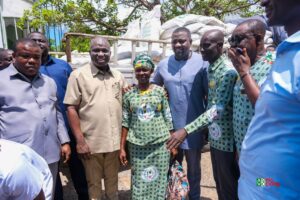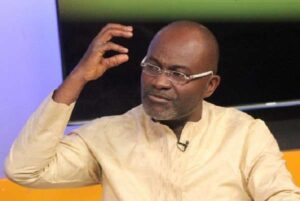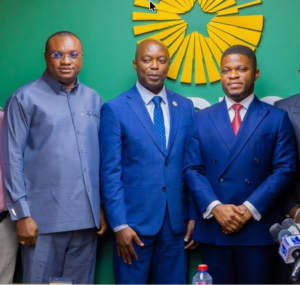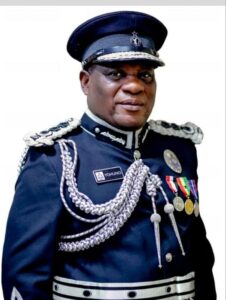
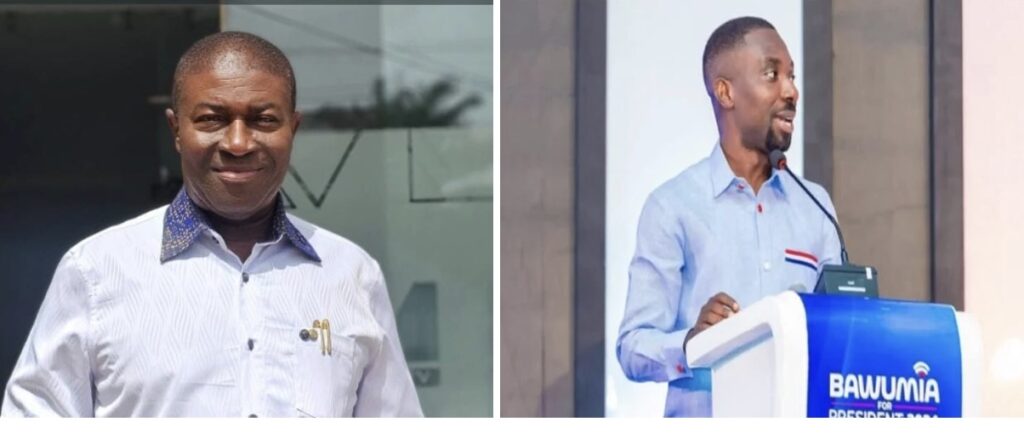
Photo: Nana Akomea and Dennis Amiracles Aboagye
• As confidence in Bawumia’s 2028 victory wobbles
IS confidence in Dr Mahamudu Bawumia’s bid to recapture power for the New Patriotic Party in 2028 beginning to crack?
That is the question increasingly being whispered in political circles following reports that two of the former Vice President’s most loyal and visible allies are contemplating bids for powerful positions within the party hierarchy.
Dennis Miracles Aboagye, one of Dr Bawumia’s fiercest defenders on the airwaves, is being tipped for the position of National Communications Director, while former Chief Executive of the Intercity STC Coaches Limited, Nana Akomea, is being linked to a possible run for National First Vice Chairman.
Neither man has officially declared his intentions.
Yet the mere suggestion that they are weighing national executive positions has ignited debate within NPP ranks about what it could mean for the future of the Bawumia project.
For many observers, the development is particularly striking in the case of Dennis Miracles Aboagye.
The outspoken communicator previously indicated on radio that he had no ambitions for executive office within the party, famously portraying himself as an “agenda boy” whose role was to advance the cause rather than seek office for himself.
That position now appears to be under intense scrutiny.
Political watchers argue that when key loyalists begin positioning themselves for party executive roles, it often reflects a broader calculation about the future political landscape.
In simple terms, if influential figures are convinced their preferred presidential candidate is destined to occupy Jubilee House in the near future, many prefer to remain within the candidate’s immediate political orbit rather than seek separate centres of power within the party structure.
It is this reality that has fuelled speculation surrounding the reported ambitions of both Aboagye and Akomea.
The two men are not peripheral actors.
They have been among the most recognisable faces associated with Dr Bawumia’s political machinery during the contest.
Their names have become synonymous with the former Vice President’s public messaging, strategic communication and political advocacy.
As a result, some party insiders are interpreting the moves as an acknowledgement that the road to 2028 may be far more difficult than initially anticipated.
The scars of the NPP’s 2024 defeat remain fresh.
Despite entering the election with the advantages of incumbency, the party suffered a setback that has triggered soul-searching across its ranks.
Questions continue to be asked about campaign strategy, messaging, economic management and voter fatigue after years in government.
Although Dr Bawumia remained the favourite, there is growing recognition that securing the party’s presidential nomination may be easier than winning over the broader Ghanaian electorate.
That distinction is becoming increasingly important.
Winning an internal contest is one thing.
Winning a national election after a significant electoral defeat is another matter entirely.
Some analysts believe ambitious politicians within the Bawumia camp may therefore be seeking to strengthen their influence within the party regardless of what happens in 2028.
By occupying key executive positions, they would retain relevance and authority whether or not the former Vice President ultimately succeeds in his presidential quest.
Others reject that interpretation entirely.
Supporters of Dr Bawumia insist there is no contradiction between backing a presidential candidate and seeking a national executive role.
They argue that strengthening the party’s organisational machinery is essential if the NPP hopes to return to power and that trusted allies taking up strategic positions should be viewed as an asset rather than a sign of declining confidence.
Still, politics is often driven as much by perception as by reality.
And right now, the perception gaining traction in some quarters is that prominent members of the Bawumia camp are quietly preparing for multiple political outcomes.
Whether that reflects strategic planning, personal ambition, or genuine concern about the former Vice President’s electoral prospects remains open to debate.
What is beyond dispute is that every movement within the Bawumia camp is now being watched closely.
And if more of his trusted lieutenants begin pursuing powerful positions within the NPP hierarchy, questions about confidence in the party’s 2028 prospects are only likely to grow louder.
About The Author