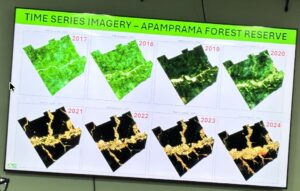
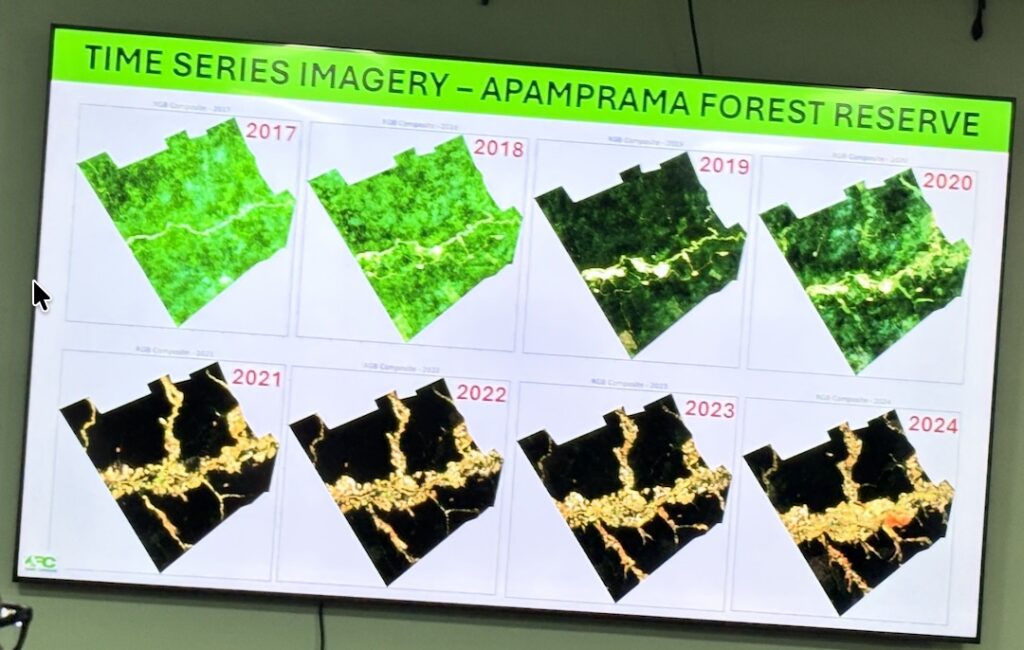
Photo: Time Series Imagery - Apamprama Forest Reserve
• Forest Slaughter Hits 8,900 Hectares as Region Bears the Brunt
The Ashanti Region has emerged as the undisputed epicentre of Ghana’s illegal mining devastation, with fresh data exposing a dramatic surge in forest destruction that has pushed the region to the top of the national shame list.
A new survey by the Forestry Commission, submitted to the Ministry of Lands and Natural Resources, shows that 8,923.8 hectares of forest reserves had been ravaged by illegal mining as of 31 December 2024. The figure marks a steep climb from the 5,252.9 hectares recorded in 2021.
More alarming is Ashanti’s share of the damage. The region alone accounts for 4,948.9 hectares of degraded forest land, more than half of the national total. The Western North Region trails behind with 2,195.7 hectares destroyed.
The numbers confirm what many environmental observers have long feared: Ashanti has become ground zero in the galamsey war, where illegal miners continue to carve through protected reserves faster than authorities can contain them.
Forest reserves under siege
Among the hardest hit are the Oda River Forest Reserve and the Apamprama Forest Reserve. In the Western North Region, the Upper Wassaw Forest Reserve has also suffered extensive degradation.
These once-thriving forest reserves, critical to biodiversity, water protection and climate stability, are now scarred landscapes marked by pits, polluted streams and stripped vegetation.
In 2021, Ashanti recorded 2,099.1 hectares of impacted reserves. By the end of 2024, that figure had more than doubled to 4,948.9 hectares, underscoring how rapidly the crisis has intensified.
Nationally, the total area of affected forest reserves rose from 766,011 hectares assessed in 2021 to 786,543 hectares in 2024, with the verified impacted portion increasing sharply.
By contrast, the Savannah Region recorded just 29.5 hectares of impact. In comparison, the Central Region reported 44.7 hectares, according to Dr Ben Torgbor, Operations Manager of the Plantations Department under the Forest Services Division.
Thin lines of defence
Behind the stark figures lies a troubling reality: enforcement agencies are struggling to keep up.
Officials cite inadequate personnel across forest districts, overstretched rapid-response teams, and persistent logistical constraints. Shortages of vehicles, surveillance equipment, protective gear and operational funding have weakened sustained enforcement.
Vast and often inaccessible forest terrains give illegal operators a tactical advantage. In Ashanti, where mining-prone belts are heavily concentrated, officers are said to be responsible for monitoring expansive territories with limited support.
The survey relied on drone and ground surveys and expert judgment. However, the 2024 assessment was based on analyses of satellite imagery from Google Earth Pro. In a few cases, drone surveys were used to validate the Google Earth results.
Dr Torgbor disclosed plans to introduce an artificial intelligence-driven monitoring system capable of automatically detecting and quantifying illegal mining activities in forest reserves. The system is expected to enhance surveillance, support policy decisions and provide regular updates on emerging hotspots.
A looming reckoning
The Commission’s Chief Executive, Dr Hugh C.A Brown, said the country would be briefed by the end of the second quarter of 2026 on the full impact of illegal mining activities recorded in 2025.
For now, however, the picture is grim.
Ashanti stands battered at the heart of Ghana’s illegal mining crisis. Unless enforcement capacity is significantly strengthened, with more boots on the ground and stronger logistical backing, officials concede the battle will remain reactive.
As the hectares of destruction climb towards 9,000 nationwide, the scars across Ashanti’s forest reserves serve as a stark warning: the cost of inaction is mounting, and the environmental debt is deepening.
About The Author