
Photo: Emmanuel Kofi Armah Buah, Minister for Lands and Natural Resources
• Destruction Soars in 3 Years
Ghana’s illegal mining menace is tearing through the nation’s forests at an alarming rate, with fresh figures showing massive devastation across protected reserves.
Official data from the Forestry Commission reveal that land destroyed by galamsey has jumped from 5,252.9 hectares in 2021 to a staggering 8,923.8 hectares by the end of 2024. That is an increase of more than 3,600 hectares in just three years.
At the heart of the destruction is the Ashanti Region, now widely seen as ground zero of the crisis. Ashanti alone accounts for 4,948.9 hectares of forest reserves wrecked, more than half of the total damage recorded nationwide.
Once lush and protected lands are now scarred by deep pits, polluted water bodies and stripped vegetation. Environmental watchers say the speed of destruction is outpacing efforts to stop it.
Reserves under siege
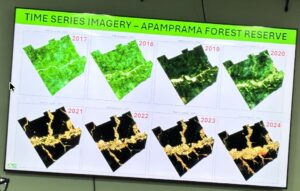
In Ashanti, major forest reserves, including the Oda River and Apamprama, have suffered extensive damage. Across the four forest districts of Nkawie, Bekwai, Mankranso, and Offinso, at least 13 reserves have been hit.
Western North follows with 2,195.7 hectares destroyed, with Upper Wassaw among the badly affected reserves.
The destruction is not limited to a few areas. From the Atewa Range in the Eastern Region to parts of the Central, Savannah and Upper East regions, illegal miners have left their mark. Even sections of Bui National Park have been cited as impacted.
But Ashanti’s figures stand out sharply. In 2021, the region recorded 2,099.1 hectares of damaged forest. By the close of 2024, that number had more than doubled, highlighting the growing intensity of operations.
Thin enforcement lines
Behind the devastation lies a harsh reality: enforcement teams are stretched thin.
Forestry officials point to limited personnel, inadequate vehicles and insufficient surveillance equipment. Vast forest landscapes provide cover for illegal miners, while rapid-response teams struggle to patrol large, remote areas.
Recent assessments relied heavily on satellite imagery and drone surveys to measure the scale of destruction. Authorities are now considering artificial intelligence systems and new monitoring platforms to detect illegal activity faster.
A forest emergency
With nearly 9,000 hectares of forest reserves degraded nationwide and more than half of them in Ashanti alone, the environmental toll is becoming impossible to ignore.
Deep craters, poisoned rivers and flattened vegetation now define parts of once-protected forest lands.
Unless stronger action is taken, experts warn that the devastation could worsen, leaving long-term scars on Ghana’s environment and threatening livelihoods tied to these ecosystems.
About The Author