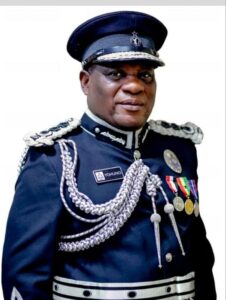

PHOTO: IGP COP Christian Tetteh Yohuno
• How Intelligence-Led Policing Is Changing the Fight Against Crime
When Christian Tetteh Yohuno was named Inspector General of Police on 13 March last year, the appointment placed him at the helm of one of Ghana’s most scrutinised public institutions. Twelve months on, his tenure is increasingly defined by a policing philosophy built around intelligence-led operations, institutional reform and a renewed focus on professionalism within the ranks of the Ghana Police Service.
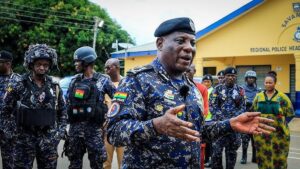
Rather than relying on spectacle, Yohuno’s approach has been notably quiet and operational. Behind the scenes, the police chief has placed heavy emphasis on intelligence gathering, coordinated raids and targeted enforcement actions designed to dismantle criminal networks before they can operate freely.
The results have been reflected in a steady flow of arrests and disrupted crime networks across the country.
A wave of intelligence-led operations
Over the past year, police operations have resulted in hundreds of arrests spanning cybercrime, trafficking, armed robbery and organised fraud.
One of the largest operations occurred in the Ashanti region, where police arrested 320 suspects during coordinated raids targeting a fraud and trafficking network linked to recruitment schemes associated with Q-Net.
Elsewhere in Accra, 25 individuals – including foreign nationals – were arrested in multiple operations targeting illegal trading and smuggling activities conducted without licences.
The police have also intensified efforts against violent crime. According to police reports, at least 78 suspects linked to armed highway robbery networks have been arrested over the past year, with 27 killed during gunfire exchanges with officers in attempts to resist arrest.
Cybercrime has become another central front in the campaign.
In December 2025 alone, intelligence sweeps across Greater Accra led to the arrest of 48 suspected cyber criminals operating from rented homes.
Later that month, a separate operation resulted in the arrest of 141 Nigerian nationals believed to have been involved in coordinated online fraud schemes across communities, including Tabora and Lashibi.
In another December operation, 16 suspects were taken into custody in Accra for crimes ranging from robbery and phone snatching to illegal arms dealing and impersonation following weeks of surveillance.
Operations beyond the capital
The crackdown has extended well beyond Accra.
In January this year, police in the Volta region dismantled a trafficking network, arresting seven suspects and rescuing 48 victims believed to have been held in exploitative conditions. Many of those rescued were Nigerian nationals.
Soon afterwards, a joint operation involving the police and the Cyber Security Authority led to the arrest of 53 suspects in raids targeting alleged cybercrime hubs in areas including East Legon Hills and other parts of the capital.
Investigations into violent robberies have also produced high-profile arrests, including suspects linked to the daylight robbery of a jewellery shop in Adabraka and members of a notorious armed robbery gang operating along mountainous highway corridors.
Order during elections
Beyond crime fighting, Yohuno’s first year has also tested the police service’s capacity to manage politically sensitive events.
Security during recent parliamentary by-elections has been widely described by observers as disciplined and controlled, with police deployments aimed at preventing clashes and maintaining order around polling stations.
The emphasis on professional election policing has been seen as part of a broader effort to reinforce public trust in the neutrality of the security services during democratic processes.
Reviving police communication
Another institutional change under Yohuno has been the reactivation and strengthening of police public relations units across the country.
The units, which serve as the primary interface between the police and the public, have resumed regular updates on arrests, investigations and security operations. Supporters of the move say it has improved transparency and helped counter misinformation surrounding law enforcement activities.
Observers note that the daily stream of updates from the police service has also contributed to the perception of a more active and responsive institution.
Clearing the promotion backlog
Internally, Yohuno’s tenure has also been marked by efforts to address longstanding welfare and career concerns within the service.
One of the most significant steps has been the clearing of a backlog of promotions affecting officers across various ranks. The move, long demanded by personnel associations, has been interpreted as an attempt to restore morale and reinforce merit-based progression within the force.
For many officers, the promotions represented more than administrative adjustments; they signalled a recognition of years of service that had previously gone unacknowledged.
Intelligence at the centre
Security analysts say the common thread running through Yohuno’s first year is the emphasis on intelligence-led policing.
Rather than relying solely on routine patrols, the strategy prioritises surveillance, informant networks and targeted enforcement operations designed to identify and dismantle criminal groups.
“It’s about knowing where the criminals are before they act,” one security analyst said. “Once the intelligence is there, the arrests follow.”
A year on
Twelve months after taking office, Yohuno’s leadership has begun to reshape perceptions of the Ghana Police Service.
From cybercrime raids in urban neighbourhoods to operations against trafficking networks and highway robbery gangs, the rhythm of enforcement has been constant.
For supporters, the message is simple: a quieter form of policing that focuses less on appearances and more on results.
If the first year of Yohuno’s tenure offers any indication, intelligence rather than visibility may well define the next chapter of policing in Ghana.
About The Author